
Japanese yankee and bōsōzoku culture: a short history with real numbers
Pompadours, embroidered long coats, roaring motorbikes at night. Japanese "yankee" culture has been parodied in manga, films and fashion around the world. Here is where it came from, how big it really was, and what is left of it today, using Japanese government statistics.
What "yankee" means in Japan
In Japanese, ヤンキー (yankee) means delinquent youth. According to Japanese dictionaries, after World War II the word was used for young people who copied the hairstyles and fashion of American youth. One major dictionary also records a sense, used mainly in the Kansai region, for flashily dressed young people hanging around town, with an example from 1973. Where exactly the word came from is still discussed; books such as Kōji Nanba’s Yankee Shinkaron (2009) explore its history.
The look
- Regent (リーゼント): a men’s hairstyle with the front piled high and the sides swept back, named after Regent Street in London.
- Tokkōfuku (特攻服): long coats worn by bōsōzoku and yankees at gatherings and fights, often embroidered with the group’s name, slogans, dragons, tigers or cherry blossoms.
- Gakuran (学らん): the stand-collar school uniform, especially the long jacket and baggy trousers associated with cheer squads.
- Sukeban (スケバン): the leader of a girls’ delinquent group, recorded in dictionaries from 1972.
Bōsōzoku: the peak and the fall
Bōsōzoku (暴走族) are groups who ride motorcycles and cars together in dangerous, noisy convoys. Japan’s White Paper on Crime records their numbers:
1978: 22,442 members · 1982: 42,510 members (the record), of whom 32,368 were juveniles · 1990: 37,155 · 2000: 23,399 · 2010: 7,850 · 2018: 5,028
(group-riding type, White Paper on Crime 2019; based on National Police Agency data)
The number of groups peaked earlier, at 817 in 1974. The early 1980s were also the peak of juvenile delinquency overall: the number of juveniles investigated for offenses reached 317,438 in 1983, the "third wave" in the White Paper’s words. In 2024 the figure was 37,941.
The laws that changed the streets
Japan’s Road Traffic Act has prohibited "joint dangerous driving" since 1978. A 2004 amendment, in force from November 1, 2004, made group reckless riding punishable even if no one was actually endangered or inconvenienced, so police could arrest riders on the spot, and created penalties for noisy riding such as revving engines while stopped. Cities also acted: Hiroshima City’s bōsōzoku ordinance, in force from April 2002, banned intimidating gatherings in public places and let the mayor order groups to leave.
Today
In 2024 the National Police Agency counted 4,483 bōsōzoku of the group-riding type in 116 groups, and nearly three quarters of them belonged to no group. Police also track "kyūshakai" (旧車會), groups formed mainly by former bōsōzoku who ride old motorcycles customized in bōsōzoku style: 391 groups with 5,194 members committing illegal acts in 2024. Researchers have also discussed "mild yankees," a label popularized in 2014 for young people attached to their home towns but without the old rebelliousness.
Living a yankee life in the simulator
In the yankee special edition, what you are arrested for follows the real mix of juvenile arrests in 2025, juvenile classification homes and training schools use the real facility names, and family backgrounds follow the White Paper finding that many juveniles in training schools live with one parent. Probabilities of arrest and outcomes are game assumptions, explained on the explainer page.
Sources: Ministry of Justice, White Paper on Crime (1993, 1998, 2019, 2025 editions); National Police Agency, White Paper on Police 2025 and statistics; Cabinet Office, White Paper on Traffic Safety 2005 and 2006; Hiroshima City Bōsōzoku Expulsion Ordinance; Digital Daijisen and Nihon Kokugo Daijiten via Kotobank; Katayama and Makino (2018), The Journal of Educational Sociology.
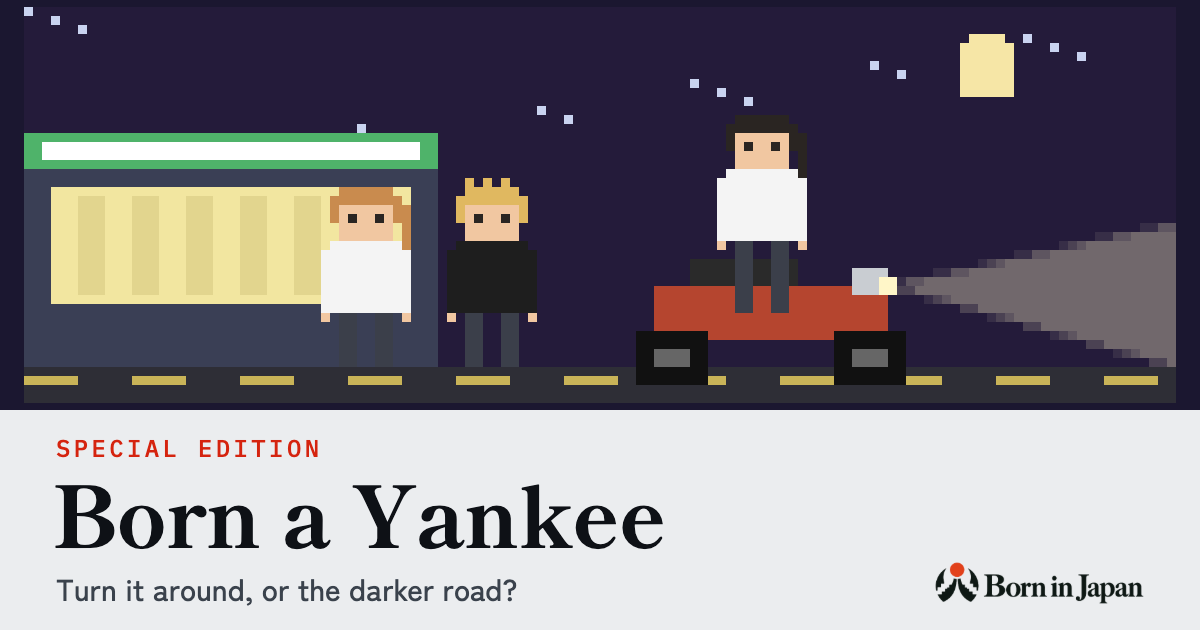
Now live it. Born in Japan is a free life simulator built on Japanese public statistics. Start the special edition and live this life one year at a time.
More guides
- Working in anime and manga in Japan: animator pay, hours and the comics market
- Teaching English in Japan on the JET Programme: ALT numbers, pay and contract length
- Oda Nobunaga: a timeline of his life from Okehazama to Honnō-ji
- Studying in Japan as an international student: numbers, work rules and staying after graduation
- How to become a sumo wrestler in Japan, and what the life is really like
- Tokugawa Ieyasu: from hostage to shogun, a timeline of his life
- Tokyo time machine: the city through the ages, from before Edo to Reiwa