
How to play Born in Japan

Born in Japan is a life simulator: you are born in some prefecture of Japan, in some year, to some family, and you live that life one year at a time to the end. This guide walks first-time players through where to play, how a life unfolds, what you can change in the settings, how your birth is decided, the main decisions, how to read the results screen and how to pick a special edition.
Where to play: any browser, phone or computer
Born in Japan runs in the browser on phones and computers alike. It is free, with nothing to download and no account to create. Open the home page, press "Be born," and a life begins right away.
- Add to home screen: choose "Add to home screen" from the menu and the game opens from an icon with one tap, like an app.
- Japanese edition: the same game is also available in Japanese as 日本に生まれる.
How to play in four steps
1. Press "Be born"
Press "Be born" on the home page and a map of Japan picks the prefecture you are born in. Then a record styled like a birth registration fills in: your name, birth year, sex, what you value, household income (how well off your family is), whether you have one parent or two, siblings, and your parents' education. Press "Begin your life" and your life starts at age 0.
2. Watch your life, one year at a time
Each year your age ticks up and that year's events are added to your record. Your net worth, this year's income, a life map (one square per year, darker in happier years) and a survival curve for people born the same sex change as you go. Around 130 events from the Showa, Heisei and Reiwa eras, such as the bubble economy, major earthquakes and the change of imperial era, reach you at whatever age you happen to be. From age 6 you can set "This year's focus" (study, friends or sport as a child; work, family, health or learning as an adult) and change it anytime.
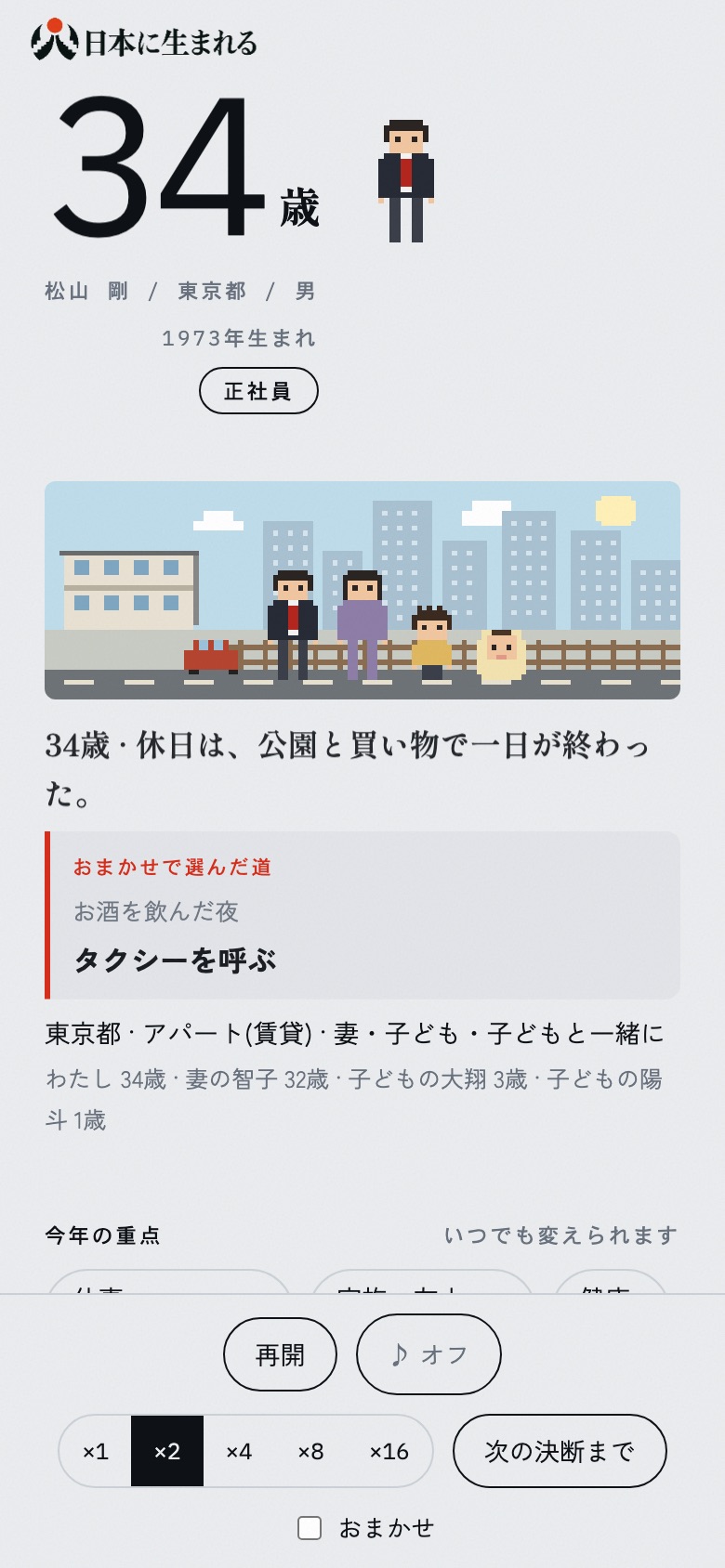
3. Make the decisions (or leave them on Auto)
Now and then a decision card appears: school, work, marriage, housing and more. Each option comes with a short note on what it is likely to change. If you are not sure, take the option marked as the Auto choice, which is the common pick. You can lower the card to look at your life before choosing, or hand all future decisions over to Auto from the card.
4. Reach the end and see your results
When your life ends, the results screen shows your rank among people born the same way, a title, lifetime income and net worth, the events of the times you lived through and more. See how to read the results screen below. One life takes about 10 to 20 minutes.
What you can change in the settings
| Setting | What it does | Where |
|---|---|---|
| Speed | Choose ×1, ×2, ×4, ×8 or ×16, or pause | Bottom of the life screen |
| To next decision | Skip ahead to the next decision | Bottom of the life screen |
| Auto | When on, the common choice is picked for you at each decision | Bottom of the life screen, decision cards |
| Generation | Leave it to chance (weighted by the number of births), or pick one of six generations born in 1947–1951, 1955–1964, 1965–1970, 1971–1982, 1983–1995 or 1996–2010. Your birth year is random within it | Menu, Settings |
| Decisions | Fewer (major decisions only), Normal, or More (including small childhood decisions). More is the default | Menu, Settings |
| Music | Turn background music on or off | Menu, and the ♪ button on the life screen |
| Today's birth | Everyone playing that day starts from the same birth, which makes it easy to compare with friends | Home page, menu |
The generation pages also have a "Be born in this generation" button that starts you in that generation.
How your birth is decided
You do not choose your starting point. It is drawn at random, weighted by statistics.
- Prefecture: in proportion to each prefecture's population, so you are far more likely to be born in Tokyo, Kanagawa or Osaka than in Tottori or Shimane.
- Birth year: a generation is drawn according to how many people were born in it, and your birth year is chosen within it.
- Family finances: where your household sits in the national income distribution, including the chance of growing up in relative poverty, based on the child poverty rate in Japan's Comprehensive Survey of Living Conditions.
- Single parent: the chance of being raised by one parent comes from the same survey.
- Siblings: from none to several, with older generations more likely to have more.
- Parents' education: whether a parent went to university, which depends on family finances and generation.
- Sex and values: your sex is random too, and what you value from birth can steer the paths you take.
For how much your birth shapes your life, see oya-gacha (the parent lottery). For the odds of being born in Japan at all, see the odds of being born in Japan.
The main decisions
Here are examples of decisions you can meet. Which ones appear depends on your birth, your earlier choices and the Decisions setting.
| Stage | Examples |
|---|---|
| Childhood | Finding something you love, choosing a school club, wanting a dog, elementary school entrance exams |
| School | Which high school track, what to do after high school (university, vocational school or work), humanities or sciences, your field of study, graduate school, studying abroad |
| Work | Your first industry, company size, changing jobs (three chances in a life), going independent, starting a company, an overseas posting |
| Love and family | Falling in love, choosing a partner, children, a marriage in crisis |
| Home and money | Renting or buying, where to keep your money, reviewing investments before retirement, buying a car, a lottery ticket |
| Small moments | Offered a cigarette, a night of drinking, a risky invitation, a relative asking for money, moving to the countryside |
| Later life | Caring for your parents, life after retirement, a new hobby, writing a will |
Beyond the decisions, things you cannot choose also happen, such as traffic accidents, crime and illness.
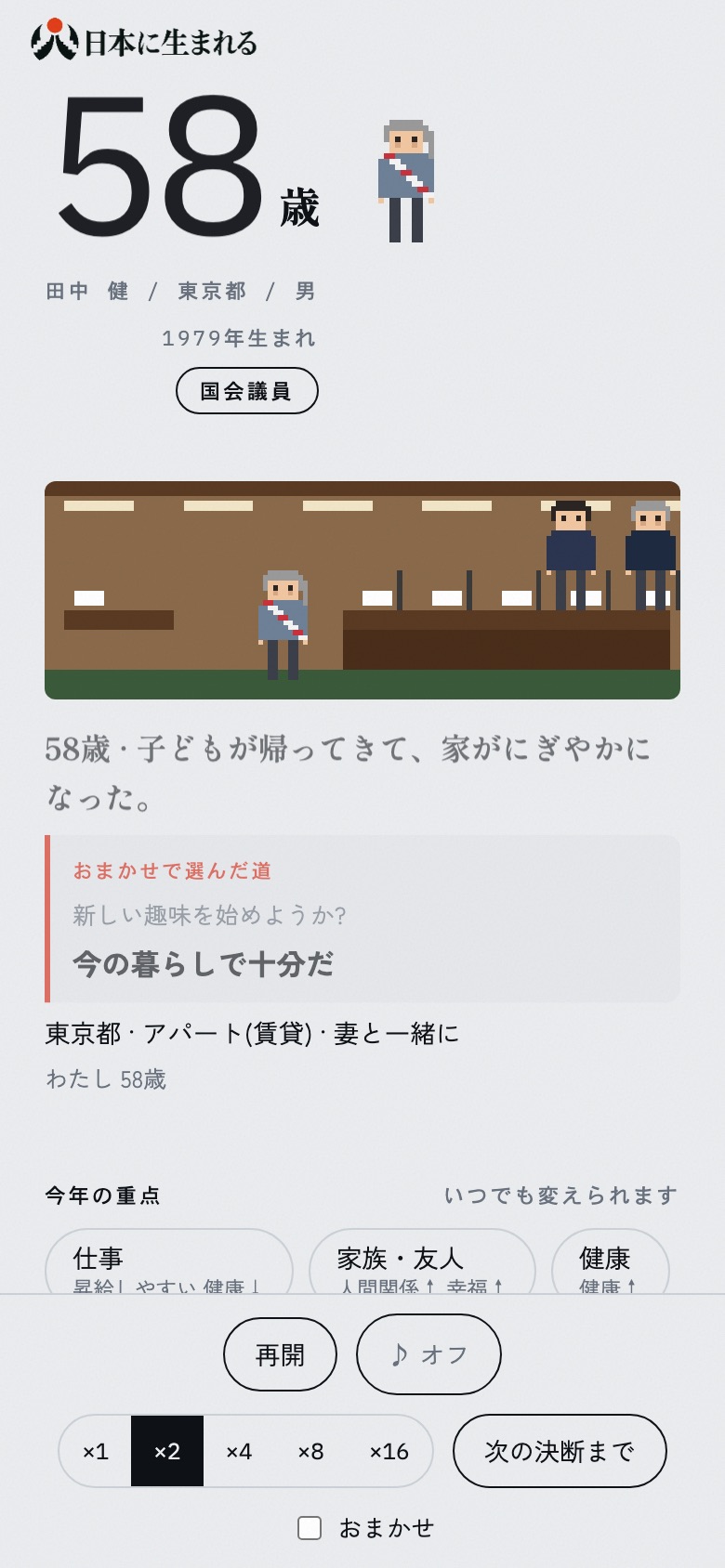
How to read the results screen
- Life story and title: a short story of where you were born, how you lived and when you died, plus a title that fits that life. There are more than 100 titles, and the screen shows how many you have found.
- Rank among the same birth: the game simulates 160 lives from your exact birth and shows where you stand on whichever of net worth, lifetime gross income or lifespan you did best in. It is not a ranking of the worth of a life.
- How rare your birth was: the combination of region, generation, sex, family finances and household, shown as "about 1 in N."
- Numbers: lifetime gross income (compared with a standard case), the difference made by birth alone, your monthly public pension, final net worth and average happiness.
- Records: your starting conditions, the choices you made, the main events of your life and the full log.
- The times you lived through: the events in Japan during your lifetime, each with your age at the time, plus Japan before you were born and sports, culture and daily-life events.
- Sharing: make a result card, highlight images, a short trailer or tall photos and share them on X, LINE or Threads, or copy a link. Anyone who opens your link can start a life from the same birth as yours.
- Play again: "Same birth, different choices" restarts from the same conditions, and "Live a different life" gives you a new birth.
Finished lives are listed anonymously in "Everyone's Lives," without names or notes, and you can choose to leave yours out.
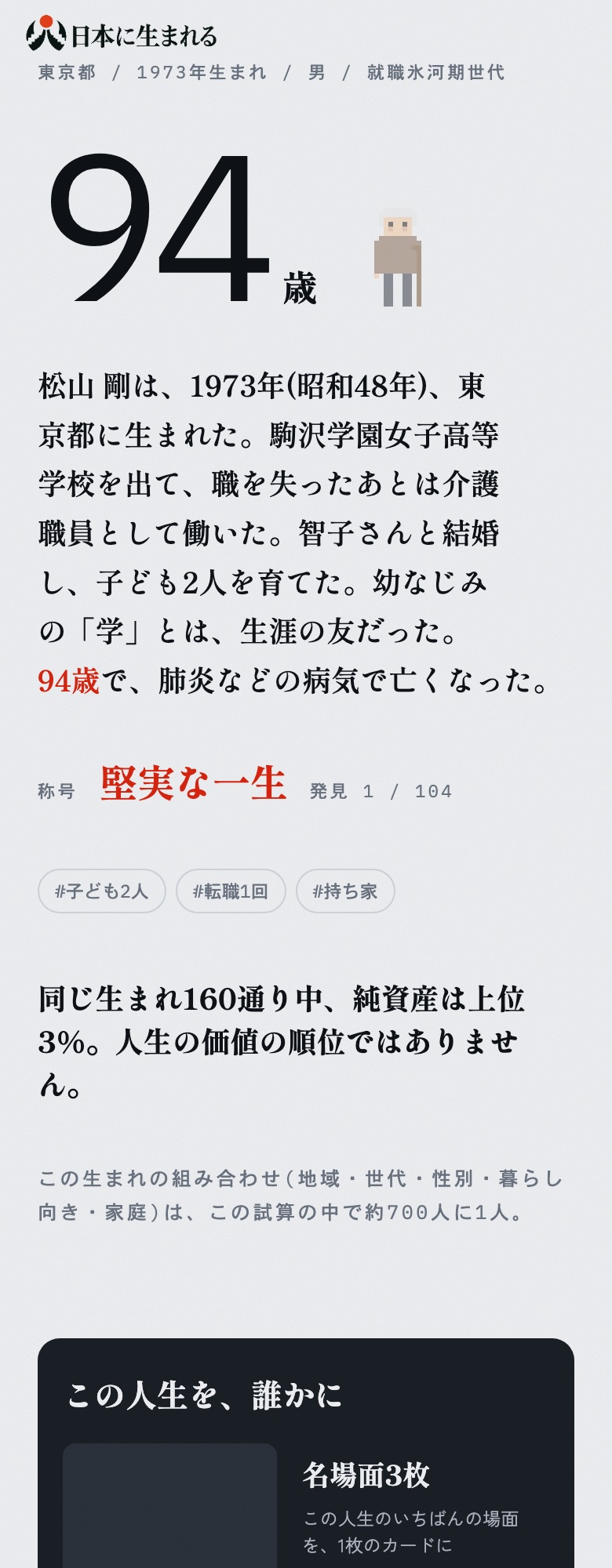
How to play the special editions
The special editions on the home page start you in a birth that leads toward a particular life. There are 40, including the history editions. How far you get still depends on luck and your choices.
- Find one: type a word in the search bar (for example baseball, love, war, travel or money), or filter by theme: Work, Love, Dreams, Family, Travel, Money or History.
- Start: press "Be born" on a card to start that life right away.
- Landing pages: "See details" opens a page about what happens in that life, the related statistics and common questions, where you can start too.
Examples include Born to be prime minister, Born into job hunting (pick your graduation year and job-hunt that year), Born in wartime, Born to travel around Japan, Oshi-katsu: living for your fave and Born for the secret unit. In the history editions, such as living as Oda Nobunaga, you choose at the turning points of real history.
How it differs from 80億分の1
The life simulator 80億分の1 ("one in 8 billion," 1in8b.life) is set across 172 countries around the world. Born in Japan narrows the stage to Japan's 47 prefectures: you are born between 1947 and 2010 and live through the Showa, Heisei and Reiwa eras, with numbers based on Japanese public statistics. A life in 80億分の1 can be set to about 30 minutes, 1 hour or 1.5 hours; a life in Born in Japan takes about 10 to 20 minutes. A side-by-side comparison of setting, play and data is on our comparison page (in Japanese).
Born in Japan is an independent work with no connection to 80億分の1 or its developer. The title is mentioned for comparison and introduction only. Titles mentioned are trademarks or registered trademarks of their respective owners.
The statistics behind it
Life expectancy, wages, college enrollment, marriage, childbirth, divorce, pensions and savings are based on Japanese public statistics such as the Abridged Life Tables, the Basic Survey on Wage Structure, Vital Statistics, the Family Income and Expenditure Survey and the School Basic Survey. Where no statistics exist (rents, house prices, expected investment returns and so on), the game fills the gap with assumptions, and the explainers show, area by area, which numbers are real data and which are assumptions. For a statistical picture of a typical life in Japan, see the average life in Japan.
Frequently asked questions
Where can I play Born in Japan?
In any browser, on a phone or a computer. It is free, with no sign-up and nothing to download. Add it to your home screen and it opens like an app.
How long does one life take?
About 10 to 20 minutes. You can change the speed from ×1 to ×16, jump to the next decision, or leave decisions on Auto.
Can I choose my birth year or prefecture?
You can choose your generation in the menu's Settings; your birth year is then random within it. Your prefecture, sex and family are drawn at random.
What if there are too many decisions?
Turn on Auto and the common choice is picked for you. You can also set Decisions to "Fewer (major decisions only)" in the menu's Settings.
Can I play the same birth as a friend?
With "Today's birth," everyone playing that day starts from the same birth. Anyone who opens your shared result link can also start from the same birth as yours.
Is Born in Japan a Japanese version of 80億分の1?
No. Born in Japan is an independent work with no connection to 80億分の1 or its developer. It is a life simulator set only in Japan.
In short
Playing Born in Japan comes down to four steps: press "Be born," watch your life year by year, make the decisions, and read your results at the end. When in doubt, use Auto; short on time, raise the speed or set Decisions to Fewer. The same birth can lead to very different lives depending on your choices and your luck. Try being born somewhere in Japan.
Play Born in Japan (free, no sign-up)
Related: The odds of being born in Japan / The average life in Japan / Oya-gacha / Generations
Next: Using a life simulator in class or with your kids: Born in Japan as a lesson on birth and choice