
Using a life simulator in class or with your kids

Born in Japan is a life simulator: you are born in some prefecture of Japan, in some year, to some family, and you live that life one year at a time to the end. When a life is over, questions tend to follow on their own: "What if I had been born somewhere else?" "Which path would I have chosen?" This page is for parents who want to play it with their children and for teachers who want to use it in a lesson about Japan. It covers how to run a session, discussion questions, and what to know before you start.
Why a life simulator gets people talking
A life simulator puts two kinds of experience side by side.
- A birth you cannot choose: your prefecture, birth year, sex, how well off your family is, whether you have one parent or two, siblings and your parents' education are all set at random, weighted by statistics.
- Crossroads you choose yourself: school, work, marriage, housing, where to keep your money and more. Each option on a decision card comes with a short note on what it is likely to change.
On top of that, some things simply happen, such as illness or accidents. In 10 to 20 minutes you watch birth, choices and luck add up to a whole life. Because it is "the life of a person in a game," it can be easier to talk about inequality, education paths, family, money, ageing and death from a little distance.
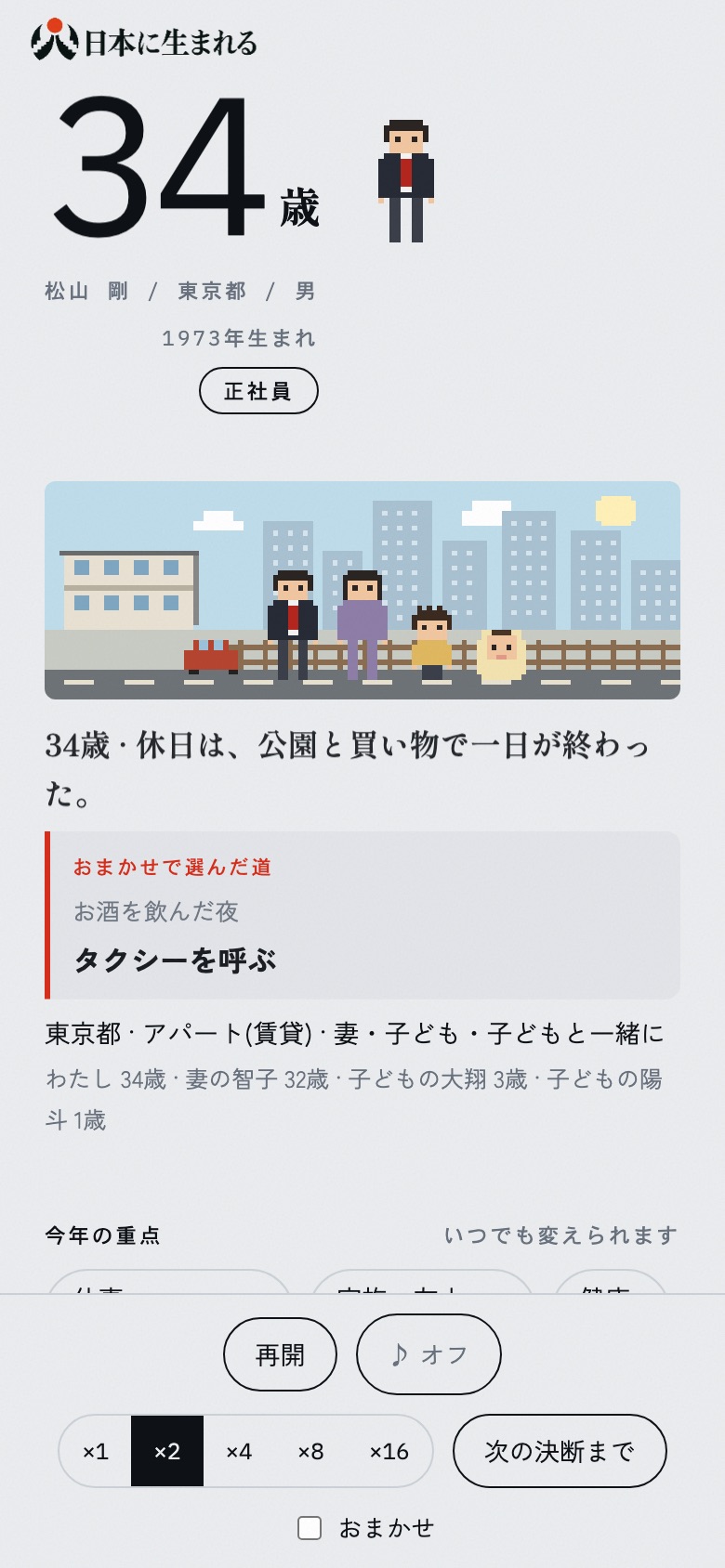
On the results screen, "Same birth, different choices" lets you replay from exactly the same circumstances. Keeping the birth fixed and changing only the choices is one of the most useful comparisons for discussion.
Playing with your kids
What age is it for?
There is no set age limit, but the game includes illness, accidents, crime, the death of family members and poverty, and one of the ways a life can end is suicide (see what to know before you play). As a rough guide, children of about 13 and up can play on their own and talk about it afterwards. With younger children, sit next to them, watch the screen together and talk through events as they happen. You know your child best, so decide what suits them.
A simple way to play together
- Play one life yourself first, so you know what kinds of events appear.
- Let your child press "Be born" and make the decisions. Ask "Why did you pick that one?"
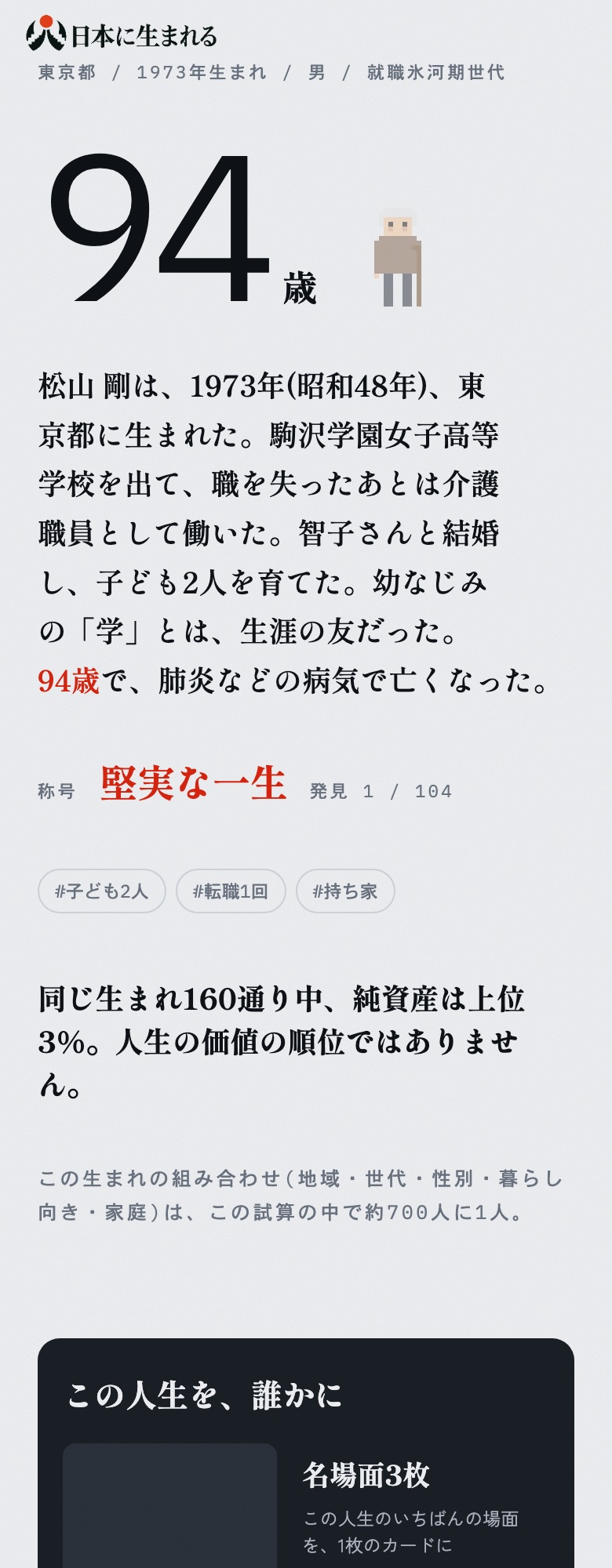
- When the life ends, read the life story on the results screen together.
- Press "Same birth, different choices," let the adult choose this time, and compare.
If everyone in the family wants the same starting point, use "Start with today's birth (the same for everyone)" on the home page. Everyone who plays that day starts from the same birth.
Things to talk about
- What changed because of the prefecture or the family? Look back at how household income, parents' education and region shaped school and work.
- How do the times change things? You meet about 130 events from the Showa, Heisei and Reiwa eras, such as the bubble economy, major earthquakes and changes of era, at whatever age you are then. Pick a generation in the menu's Settings and play the years your grandparents or parents were born.
- Which path would you choose? Go back to a decision you hesitated over and think it through again. There is no right answer.
- Was this person happy? A life with a large net worth or a life full of family and friends: which was better depends on who you ask.
The results screen shows a rank such as "top 3% for net worth among 160 lives with the same birth." It compares numbers like money and lifespan inside the game. It is not a ranking of the worth of a life, and it helps to say so.
Using it in class
It runs in the browser on phones, tablets and computers, with no sign-up and nothing to install. With one device per student, everyone can live a life of their own; with fewer devices, pairs or small groups can share one and agree on each decision. For classes outside Japan, it works well as a lesson on Japanese society: regional differences, generations, work and the welfare system.
A sample 45–50 minute lesson
| Time | Activity | Notes |
|---|---|---|
| 5 min | Introduction | Ask: "Can you choose where and into what family you are born?" Before playing, mention that difficult events appear and that the rank is not the worth of a life |
| 15 min | Everyone lives one life | Use today's birth if you want the whole class to start the same way. Raise the speed or use Auto so everyone finishes in time |
| 10 min | Replay the same birth and compare | Press "Same birth, different choices" and change only the decisions. Note what changed and what did not |
| 5 min | Check the real numbers | Open an explainer page to see the public statistics behind the game (for example oya-gacha or where and into what family you are born) |
| 10 min | Discussion | Groups pick one or two of the discussion questions below |
| 5 min | Reflection | Each student writes one sentence on "what birth decides" and one on "what I can choose" |
Where it fits
- Social studies and civics: inequality, regional differences in wages and university entry, pensions and social security.
- Japanese studies, geography and history: Japan's 47 prefectures and the Showa, Heisei and Reiwa eras, lived at the age you would have been.
- Economics, personal finance and home economics: renting or buying, saving and investing, marriage, raising children and caring for parents.
- Careers education: choosing schools and jobs, changing jobs, going independent, and the "How to become..." guides on special editions.
- Ethics and personal development: empathy for people facing things they did not choose, and what a good life means.
These are only examples; shape the lesson around your own aims.
Discussion questions
Questions by theme, with explainer pages to read alongside. Checking the numbers lets students ask, "That happened in the game, but what do the real statistics say?"
| Theme | Questions | Read alongside |
|---|---|---|
| Birth and inequality (oya-gacha) | How did household income change the paths open to you? Japanese has a word, "oya-gacha" (the parent lottery). What do you think of it? What could society do to narrow gaps from birth? | Oya-gacha |
| Region (prefecture) | What might have changed if you had been born in another prefecture? How do cities and rural areas differ in your own country? | Where you are born |
| The times (generation) | At 22, how does finding a job differ by birth year? Play your parents' generation: what surprised you? | Japanese generations |
| Work | What conditions or qualifications does a job need? Was the life after getting it what you imagined? | "How to become..." on special editions (doctor, chef, manga artist, prime minister and more) |
| Money | What made the biggest difference to lifetime income? How did your game life compare with the average? | The average life in Japan / Savings and investing |
| The end of life (lifespan) | How long did you live? Is living long the same as living well? How rare is it to be born in Japan at all? | How long you live / The odds of being born in Japan |
A few numbers to start from: in 2024, Japan's child poverty rate (age 17 and under) was 11.0%, about 1 child in 9 (Ministry of Health, Labour and Welfare, 2025 Comprehensive Survey of Living Conditions). Life expectancy at birth in 2025 was 81.35 years for men and 87.33 years for women (MHLW, 2025 abridged life tables). Of the roughly 8.2 billion people alive today, about 1 in 67 lives in Japan. Sources are listed on each explainer page.
What to know before you play
Events in the game
Born in Japan shows not only happy moments but also hard things that happen in real lives. They include:
- Illness (cancer, heart disease, stroke and others) and accidents, including traffic accidents
- Major disasters such as earthquakes, met as events of the times if you are alive that year
- The death of a parent or spouse
- Family poverty, losing a job, debt, bankruptcy and public assistance
- Taking time off work for depression
- Being a victim of fraud or other crime, offers of shady work, and arrest
- A scene where a neighbour's child may be suffering abuse (with a note on Japan's child-abuse hotline, 189)
- A life can end in old age or illness, but also in an accident, or in suicide while struggling with mental health
Which of these happen depends on birth, choices and luck. Some special editions, such as Born in wartime, depict war.
Care for children with hard experiences
For a child who has lost a family member or is going through a hard time at home, events in the game may feel close to their own life. In class, tell students in advance what may appear and offer ways to take part (watching only, playing in a pair, or a different task). In discussion, do not ask students to talk about themselves or their families; talk about "this person in the game."
The numbers mix public statistics and game assumptions
Lifespan, wages, university entry, marriage, pensions and more are based on Japanese public statistics, and gaps are filled with game assumptions. Which is which is set out area by area in the explainer pages. The simulation does not predict any real life or anyone's future. In class, keep "what happened in the game" and "what the statistics say" separate.
The rank is not the worth of a life
The rank on the results screen is a game estimate that compares net worth, lifetime income or lifespan among 160 lives with the same birth. It does not judge or rank any real person, family or region.
If someone needs to talk
If you are a child or young person in Japan who needs to talk to someone, the education ministry's 24-hour children's SOS line is 0120-0-78310 (free, in Japanese). Outside Japan, please point students to the support services available where you live.
Adding a global view
The life simulator 80億分の1 ("one in 8 billion") is set across 172 countries around the world. Born in Japan narrows the stage to Japan's 47 prefectures, so the two together make for a lesson comparing "Japan in the world" with "you within Japan." For example: first play 80億分の1 and ask what changes depending on the country you are born in, then play Born in Japan and ask how much still changes within one country, by prefecture and family. A side-by-side comparison of setting, play and data is on our comparison page (in Japanese).
Born in Japan is an independent work with no connection to 80億分の1 or its developer. The title is mentioned for comparison and introduction only. Titles mentioned are trademarks or registered trademarks of their respective owners.
Schools and organisations
Anyone can use the free version in class as it is, with no sign-up. For schools, companies and local governments, the For schools and organisations page describes paid plans that include a lesson guide and worksheets, discussion questions and a whole-class shared birth. The educational effect in classes and training has not yet been evaluated; we are assessing it together with early partners.
FAQ
What age is it suitable for?
There is no set age. Because illness, accidents, crime, the death of family members and poverty appear, about 13 and up is a rough guide for playing alone. With younger children, play together and watch the screen with them.
Is it free? Do students need to sign up?
It is free, with no sign-up and nothing to download. Press "Be born" in the browser and a life begins. There are paid plans for schools and organisations, but the free version can be used in class as it is.
Can a life fit into one lesson?
One life takes about 10 to 20 minutes. You can change the speed from ×1 to ×16, jump to the next decision, or leave decisions on Auto. Setting Decisions to "Fewer" in the menu's Settings keeps only the major ones.
Does it work on tablets and school laptops?
It runs in the browser on phones, tablets and computers. Nothing needs to be installed.
Can the whole class start from the same birth?
Yes. With "Start with today's birth," everyone who plays that day starts from the same birth. Anyone who opens a shared result link can also start from the same birth.
Is students' personal information sent anywhere?
No account is needed, and every character is a fictional person generated by the game. Play records are saved in the browser on the device, and text that players type, such as notes, is not sent to analytics. A finished life appears anonymously in "Everyone's Lives" as a summary without player-entered names or notes, and pressing "Don't show it" on the results screen hides it. See the privacy policy for details.
Summary
A life simulator lets you watch a birth you cannot choose, the crossroads you can, and plain luck add up to a whole life in a short time. At home it can start a conversation about "What would you do?"; in class, alongside the statistics, it can open up questions about inequality, education, work and everyday life in Japan. Before you start, mention that hard events appear and that the rank is not the worth of a life.
Play the life simulator Born in Japan (free, no sign-up)
Related: How to play / Oya-gacha / Where you are born / Generations / The average life in Japan / The odds of being born in Japan / For schools and organisations